How to Use eRank to Find Etsy Keywords (Free Plan)
A plain walkthrough of eRank's free keyword tool: read the numbers, find low-competition long-tail Etsy keywords, and turn them into titles and tags.
You do not need a paid subscription to do real keyword research for your Etsy shop. The free plan of eRank is enough to find the phrases buyers actually type, and it is the tool I open first every time I plan a listing.
This is the exact routine I use, with real numbers I pulled from eRank this week. No theory, just the clicks and the choices.
A quick note: some links here are affiliate links, so I may earn a small commission if you sign up. It never costs you anything extra.
What eRank’s free plan gives you for Etsy keywords
eRank reads Etsy’s own search data and shows you how often a phrase gets searched and how crowded it is. The free plan limits you to about five keyword searches a day. That sounds tight, but if you search on purpose instead of poking around, five is plenty. The trick is to spread them out: do a few today, a few tomorrow, and you slowly build a list. If you are weighing whether the paid plans are worth it, I broke that down in my honest eRank review.
Try eRank free
Step 1: Start with one seed keyword
Open the Keyword Tool, make sure it is set to Etsy, and type the most obvious word for your product. I started with “planner.”
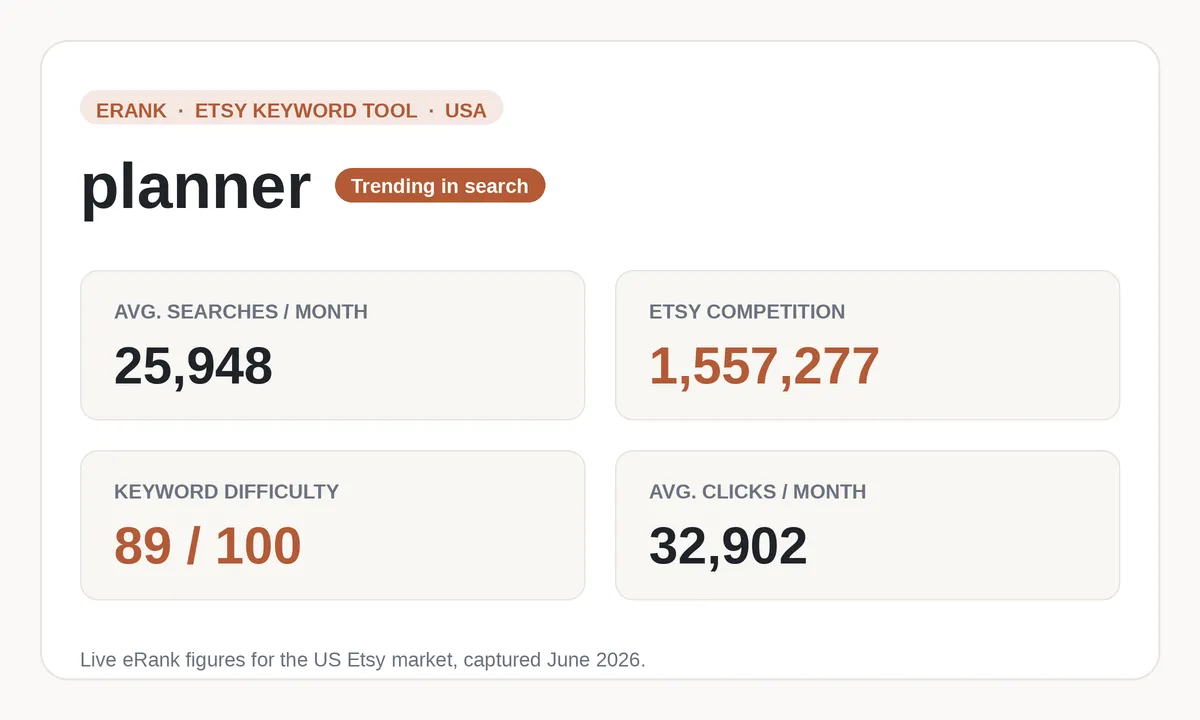
About 25,948 searches a month. Tempting. But look at the competition: 1,557,277 live listings already fighting for that word. For a brand new shop, a number like that means page 40, where nobody scrolls. The big seed word is almost never the answer. It is just the doorway to better ones.
How to read the four numbers eRank shows you
Before you go further, it helps to know what each number on the result actually means.
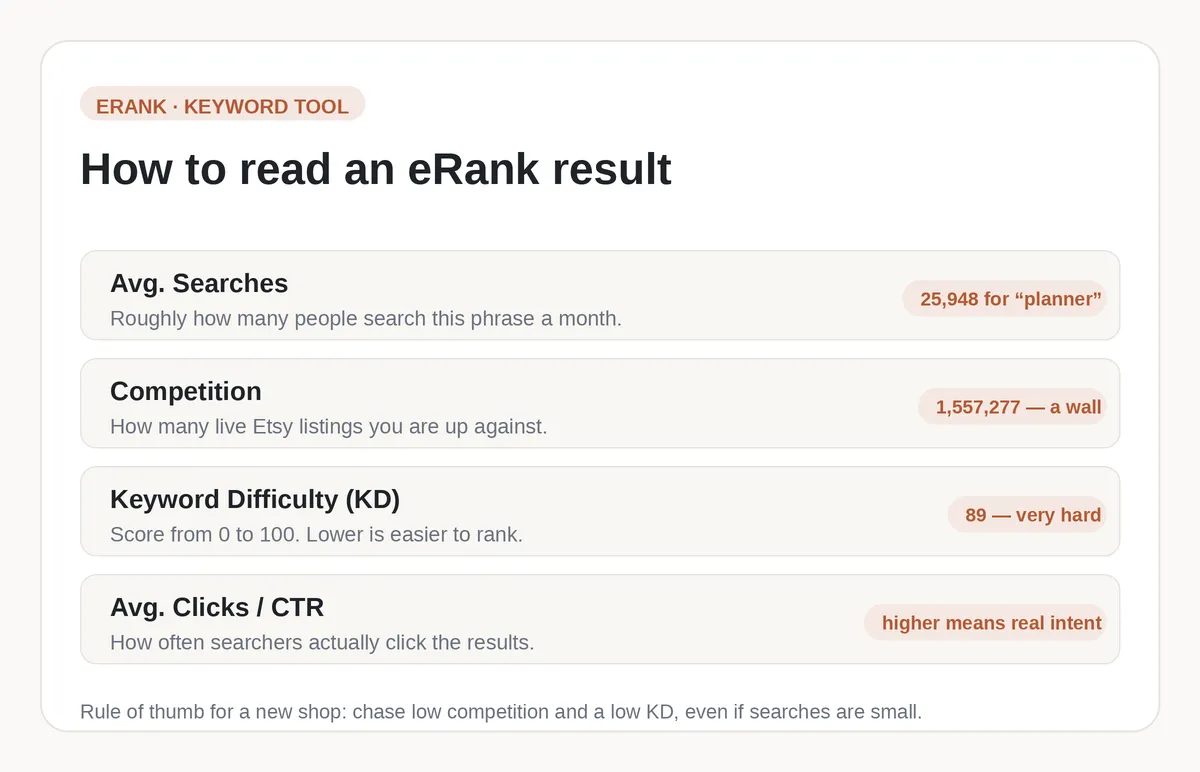
The two that matter most for a new shop are competition (how many listings you are up against) and keyword difficulty, the 0 to 100 score where lower is easier. “Planner” scored 89, which is about as hard as it gets. eRank also flags when a term is trending and shows where searchers are based, which is useful later, but competition and difficulty are what keep you off page 40.
Step 2: Raid the related keyword list
Under the main result, eRank lists related keywords. This is the gold. Scroll down and read it.
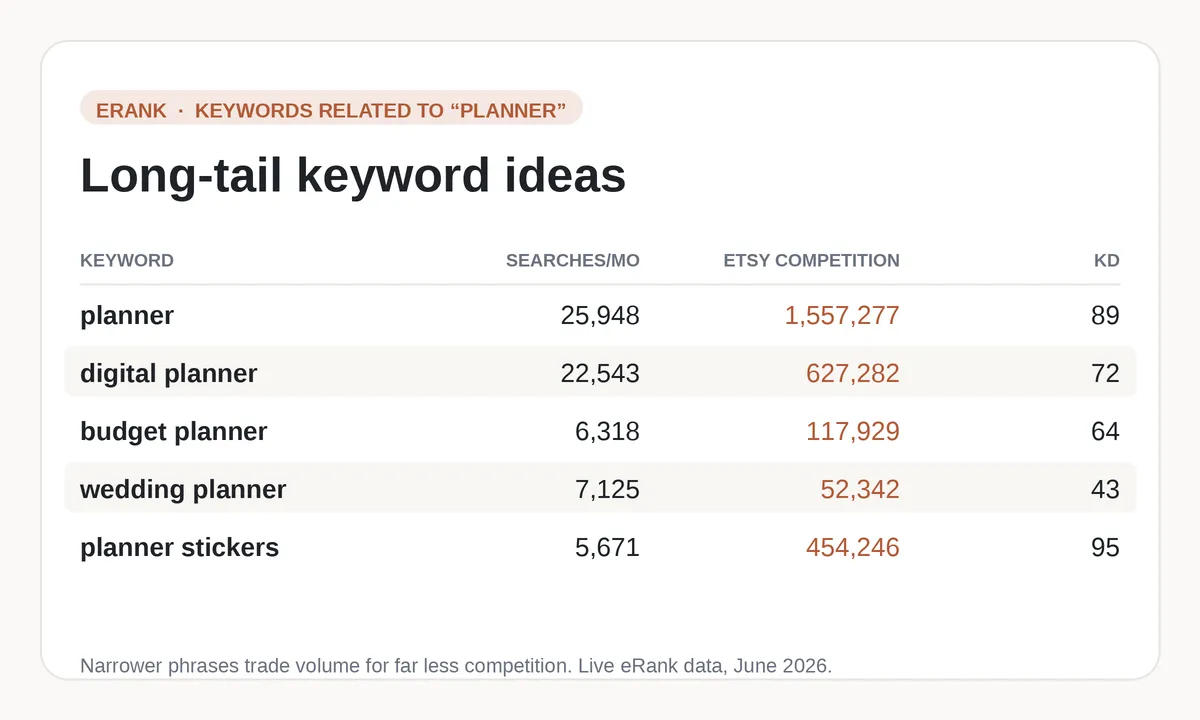
Watch how the competition drops as the phrases get more specific. “Digital planner” still has 627,282 listings. “Budget planner” is down to 117,929. “Wedding planner” sits at 52,342. Same family of products, but each narrower phrase is a smaller, more winnable room. On the free plan eRank shows you a handful of these with full data and locks the rest, but a handful is enough to spot the pattern.
Step 3: Pressure-test the phrases you would actually use
Now search the full phrase a real buyer would type for your specific product. This is where you spend a search or two on purpose. I checked two:
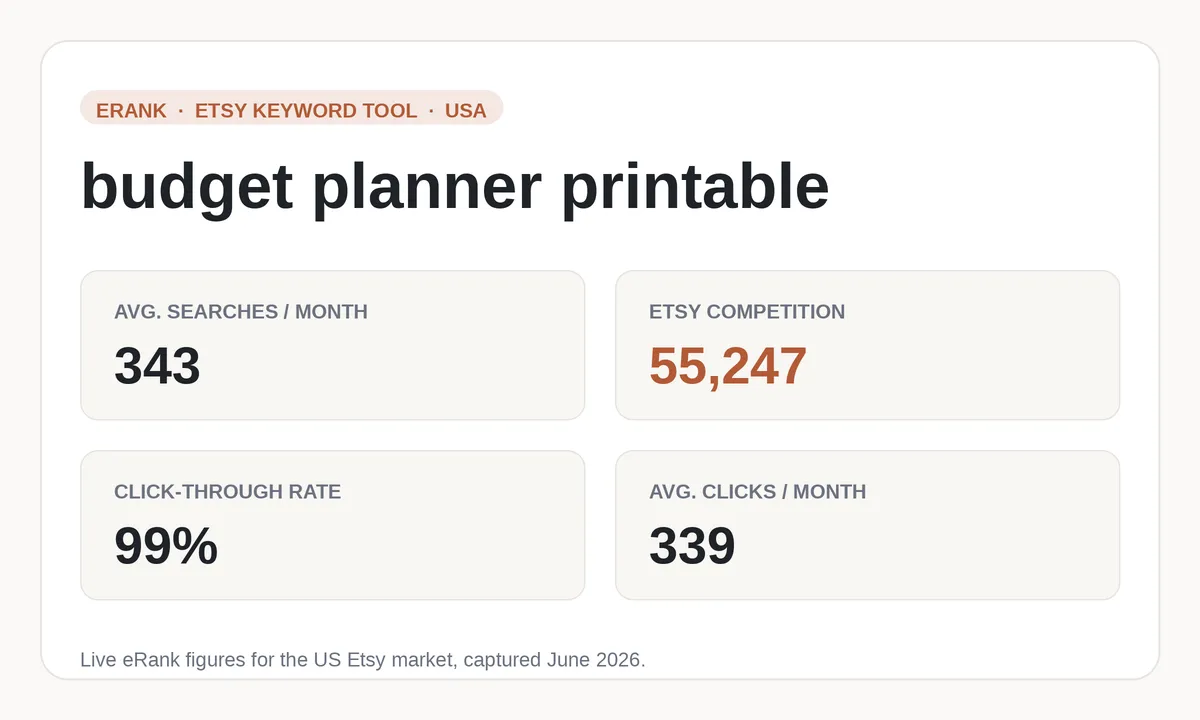
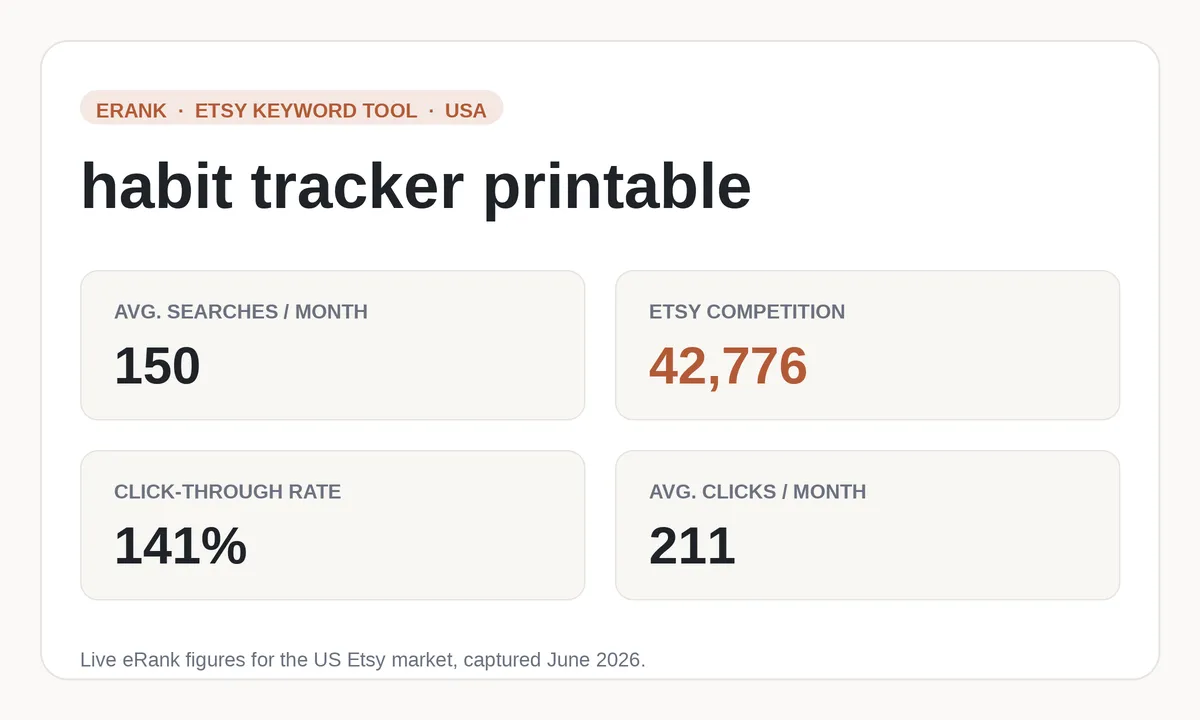
“Budget planner printable” gets 343 searches against 55,247 listings. “Habit tracker printable” gets 150 against 42,776. Far fewer people searching than “planner,” but you trade that for a real shot at being seen instead of buried. That trade is the whole game for a new shop.
Step 4: Pick targets you can actually win
Here is the rule I follow. As a new shop, favor low competition and a low difficulty score over a big search number. A phrase with 150 searches you can rank for beats 25,000 searches you never will. Write down five or six specific phrases that describe your product closely and have the lowest competition you can find. Those become your raw material.
Step 5: Turn the words into titles and tags
Finding the words is half the job. The other half is placing them well: the most important phrase near the front of your title, and the rest spread across all 13 tags without repeating yourself. I wrote a full walkthrough of that in the Etsy SEO guide for beginners, so start there once your list is ready.
Make it a weekly habit
Because the free plan caps you at around five searches a day, treat keyword research as a small, steady routine rather than a one-time binge. A few searches a day, a growing list in a notes file, and within a couple of weeks you have a keyword bank to pull from every time you list something new.
Start with eRank’s free plan
That is the entire routine: find the words people really type, pick the ones you can win, then build your listing around them. Once you have your keywords sorted, the next questions are what to charge for your printables and which tools to design them in.
Some links in this article are affiliate links. See our Affiliate Disclosure.
← Back to all articles