Etsy SEO for Beginners: Get Your Listings Found in 2026
A plain-English guide to Etsy SEO for new sellers. How keywords, titles, and tags work, and the free tool I use to find what buyers search.
You did the hard part. You made something good, you listed it, and then… nothing. No views, no favourites, no sales. It feels like you put your shop in a room with the lights off.
I have been there. The thing nobody tells you when you start on Etsy is that listing a product is not the same as being found. Etsy has millions of listings, and most of them never get seen. The sellers who do get seen are not always the ones with the best products. They are the ones who understood how Etsy decides what to show.
That is what this guide is about. No jargon, no fluff. Just how Etsy search actually works and what you can do this week to start showing up.
Etsy is a search engine, not a gallery
Here is the one idea that changes everything. Etsy is basically a search engine, like Google but for handmade and digital products. When a buyer types “minimalist weekly planner” into that search bar, Etsy looks at every listing and tries to pick the ones that best match those words.
So your job is simple to say and a little harder to do: use the exact words your buyers are typing. If someone searches “budget planner printable” and your listing says “Financial Organisation Document,” you will never meet, even though you are selling the same thing.
SEO just means “search engine optimisation,” and on Etsy it mostly comes down to three things you control: your title, your tags, and to a smaller degree your description and attributes. Get those matching what buyers search, and Etsy starts putting you in front of people.
Step 1: Find out what buyers are actually searching
This is the part most beginners skip, and it is the most important. You cannot guess the words in a buyer’s head. You have to look them up.
When I started, I would type a phrase into a keyword tool and just see the truth, in numbers. The tool I use for this is eRank, and the free plan is enough to get going. It tells you roughly how many people search a phrase each month and how much competition there is for it.
Let me show you why this matters with a real example. When I searched “planner” in eRank, it showed about 25,948 searches a month in the US. My first reaction was, perfect, I will target that. But that is a trap, and here is why.
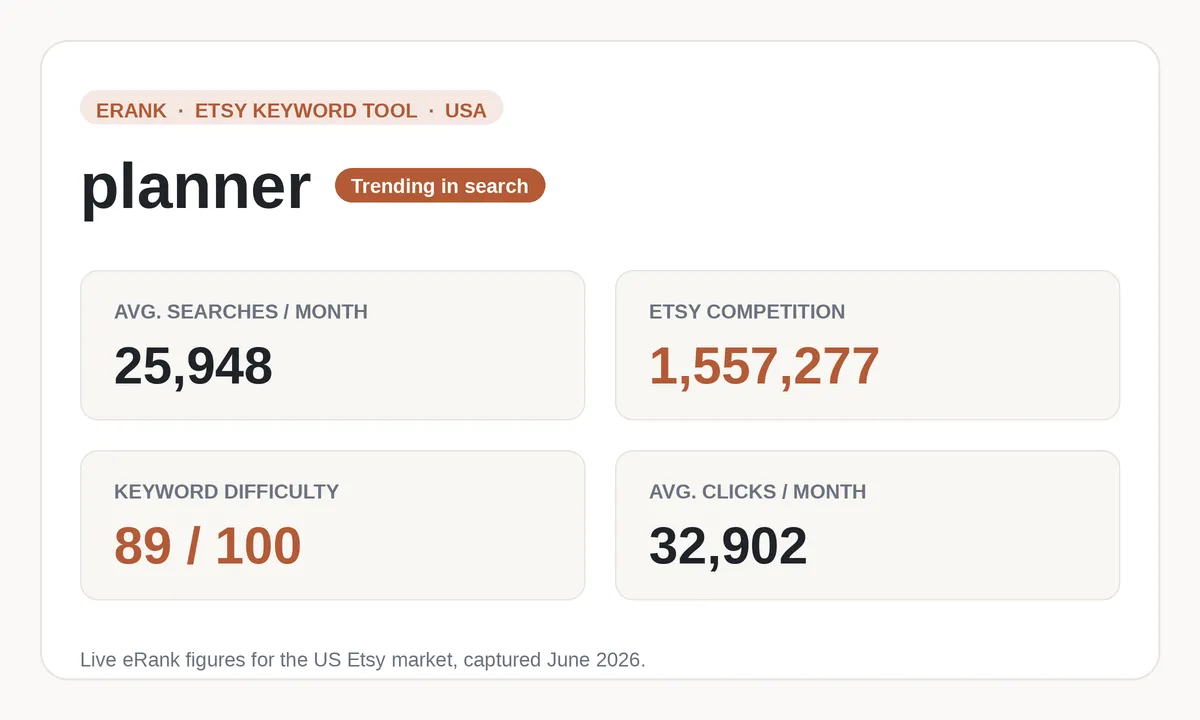
A term like that also has a wall of competition. eRank put “planner” at 1,557,277 competing listings. As a brand new shop, you will sit on page 40 where nobody looks. It is like opening a tiny coffee stall next to a hundred Starbucks.
The move that actually works is going for long-tail keywords. Those are longer, more specific phrases with fewer searches but far less competition. “Planner” is a war zone. “Minimalist undated weekly planner printable” is a quiet street where you can actually be the best shop on it.
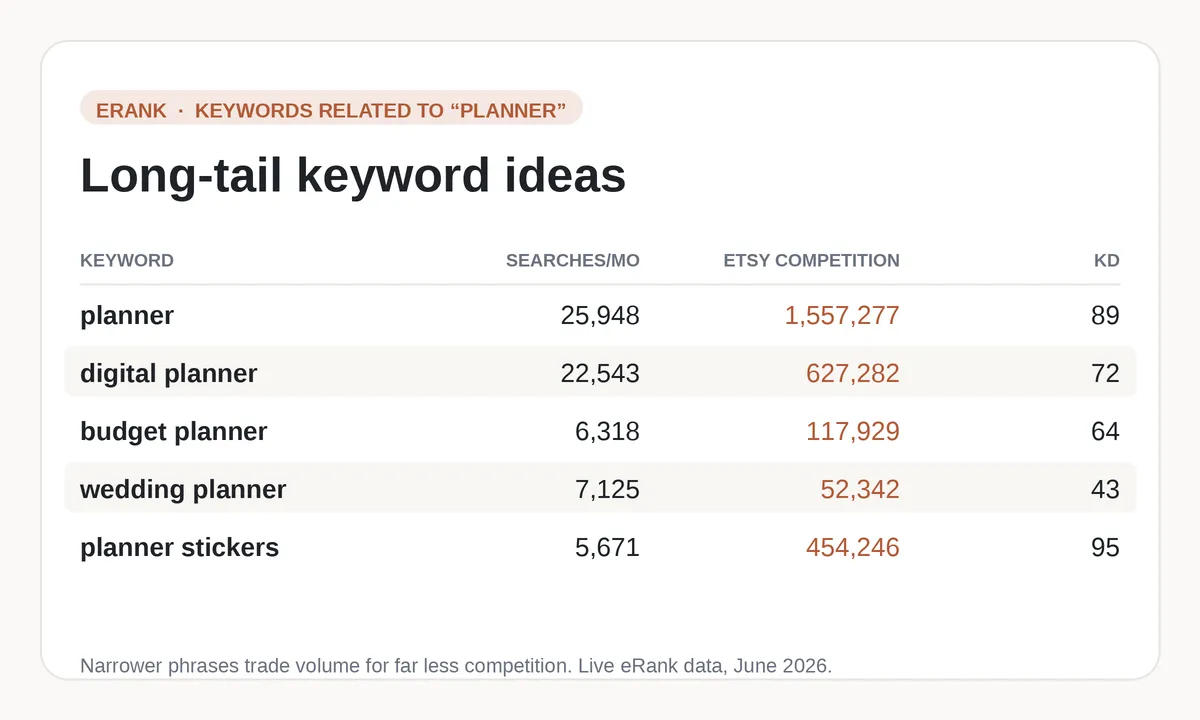
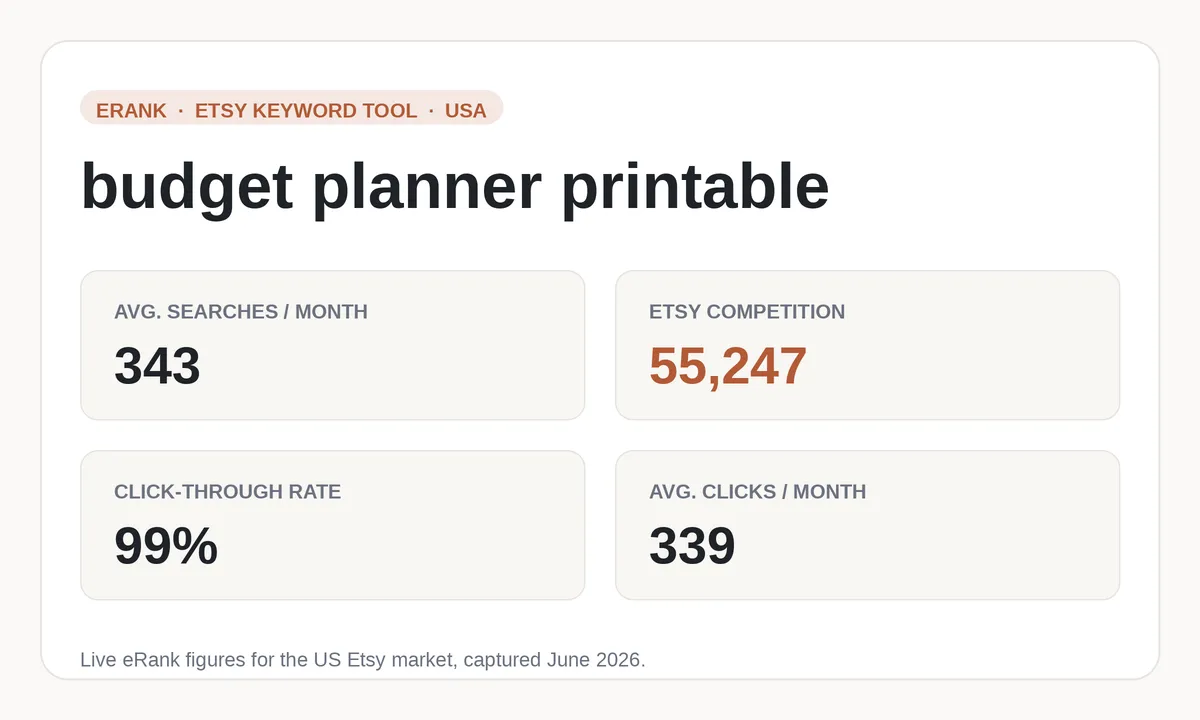
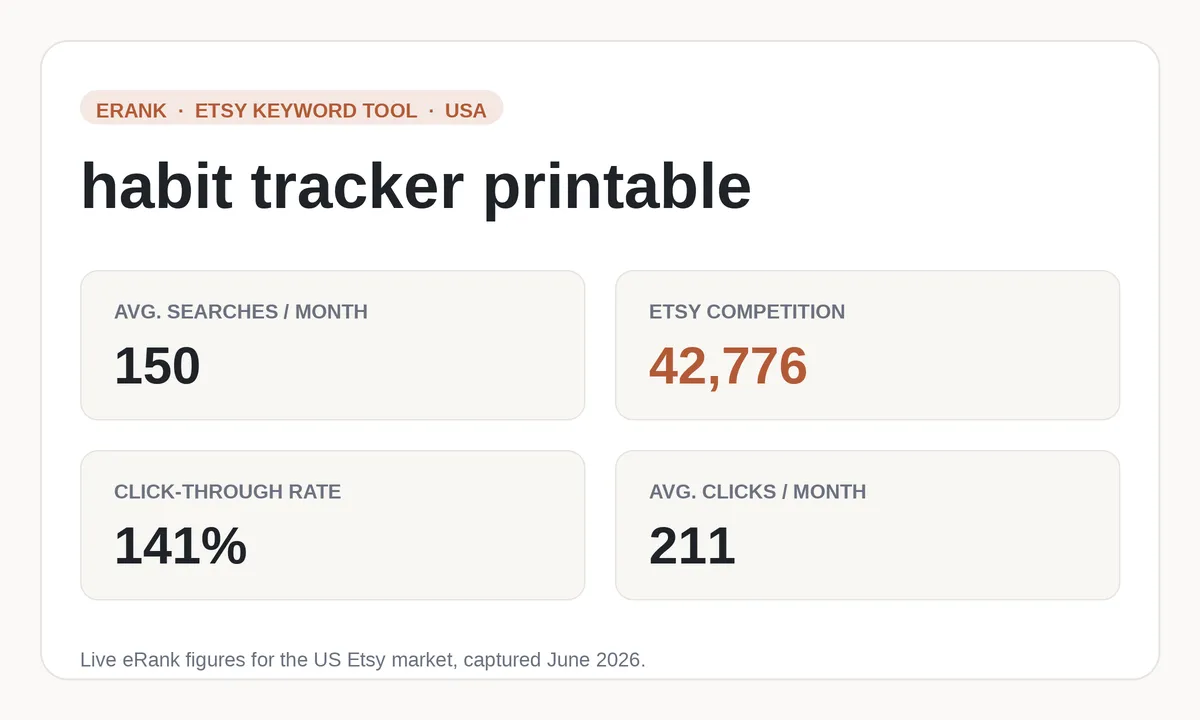
Here is the contrast in real numbers. “Planner” pulls 25,948 searches a month but sits against 1,557,277 competing listings. Now look at two narrower phrases I checked the same day: “budget planner printable” gets 343 searches against just 55,247 listings, and “habit tracker printable” gets 150 searches against 42,776. Far fewer people searching, but a real chance of actually being seen by them.
So when you sit down with eRank, do this:
- Search the obvious broad word for your product. Note the volume and competition. Notice how scary the competition is.
- Look at the long-tail suggestions it gives you underneath. Write down five or six that describe your product closely and have lower competition.
- Those phrases become the raw material for your title and tags.
If you want this part walked through click by click, I made a separate step-by-step guide to using eRank.
A quick note: some links here are affiliate links, so I may earn a small commission if you sign up. It never costs you anything extra.
Try eRank free
I use the free plan myself and it covers the basics. It limits how many searches you get per day, so do a few, come back tomorrow, do a few more. You do not need to pay anything to start.
Step 2: Write a title that uses those words
Now you have a list of phrases buyers really type. Put them to work in your title.
Two rules that matter. First, put your most important keyword near the front, because Etsy gives early words a little more weight. Second, write it for a human too, not just the robot. A title stuffed with random words looks like spam and people scroll past it.
So instead of “Planner Printable Digital Download Instant PDF Planner Planner,” write something like “Minimalist Weekly Planner Printable, Undated Weekly Schedule, Instant Download PDF.” It reads naturally and it is packed with real search phrases.
Step 3: Use all 13 tags, and do not waste them
Etsy gives you 13 tags per listing. Use every single one. An empty tag is a door you left locked.
A few things I learned the slow way:
- Use multi-word phrases, not single words. “Habit tracker” beats “habit,” because almost nobody searches one bare word.
- Do not repeat the exact same phrase your title already nailed. Spread your net wider. Cover the different ways people might describe the same thing.
- Think about the buyer’s situation, not just the product. Someone might search “new year planner” or “student budget sheet.” Those are tags too.
Step 4: The things people forget
Keywords get you into the race. These get you a better finish.
Fill in every attribute and pick the most specific category Etsy offers, because buyers filter by these and the algorithm reads them. Put a clear sentence using your main keyword in the first line of your description, since that opening matters more than the rest. And complete your shop fully, with an about section, policies, and a profile, because Etsy trusts finished shops more than empty ones.
A bit of honesty about how long this takes
Here is the part the “make money fast” videos leave out. Etsy SEO is not instant. After you optimise a listing, it can take a few weeks for Etsy to gather enough data to decide where you belong in search. New shops also get a small temporary boost, then settle.
So do not panic if nothing happens on day three. Optimise properly, then give it time. The sellers who win are the ones who keep going while everyone else quits at week two.
Your simple plan for this week
If you do nothing else, do this:
- Pick one listing.
- Open eRank, find five or six real long-tail phrases for it.
- Rewrite the title with the best phrase near the front.
- Fill all 13 tags with the rest, plus a few buyer-situation phrases.
- Save it, and leave it alone for a few weeks.
Then repeat for your next listing. That is the whole game, one listing at a time.
Start with eRank’s free plan
That is genuinely how I do it. Find the words, use the words, be patient. Your products are already good. Now you are just making sure people can find them.
Once buyers can find your listings, the next question is what to charge for them. I wrote a separate guide on how to price your printables without underselling yourself. And if your listings need to look the part first, here are the design tools I use to make printables.
Some links in this article are affiliate links. See our Affiliate Disclosure.
← Back to all articles